Blog · Isothermal amplification ·
Chairside molecular testing: what changes when PCR-grade results arrive in 30 minutes
For twenty years the clinic's choice was a rapid antigen test now or a laboratory PCR in two days. Isothermal amplification adds a third option: a sealed test card that amplifies nucleic acid at a single temperature on a palm-sized dock and reports before the consultation ends.
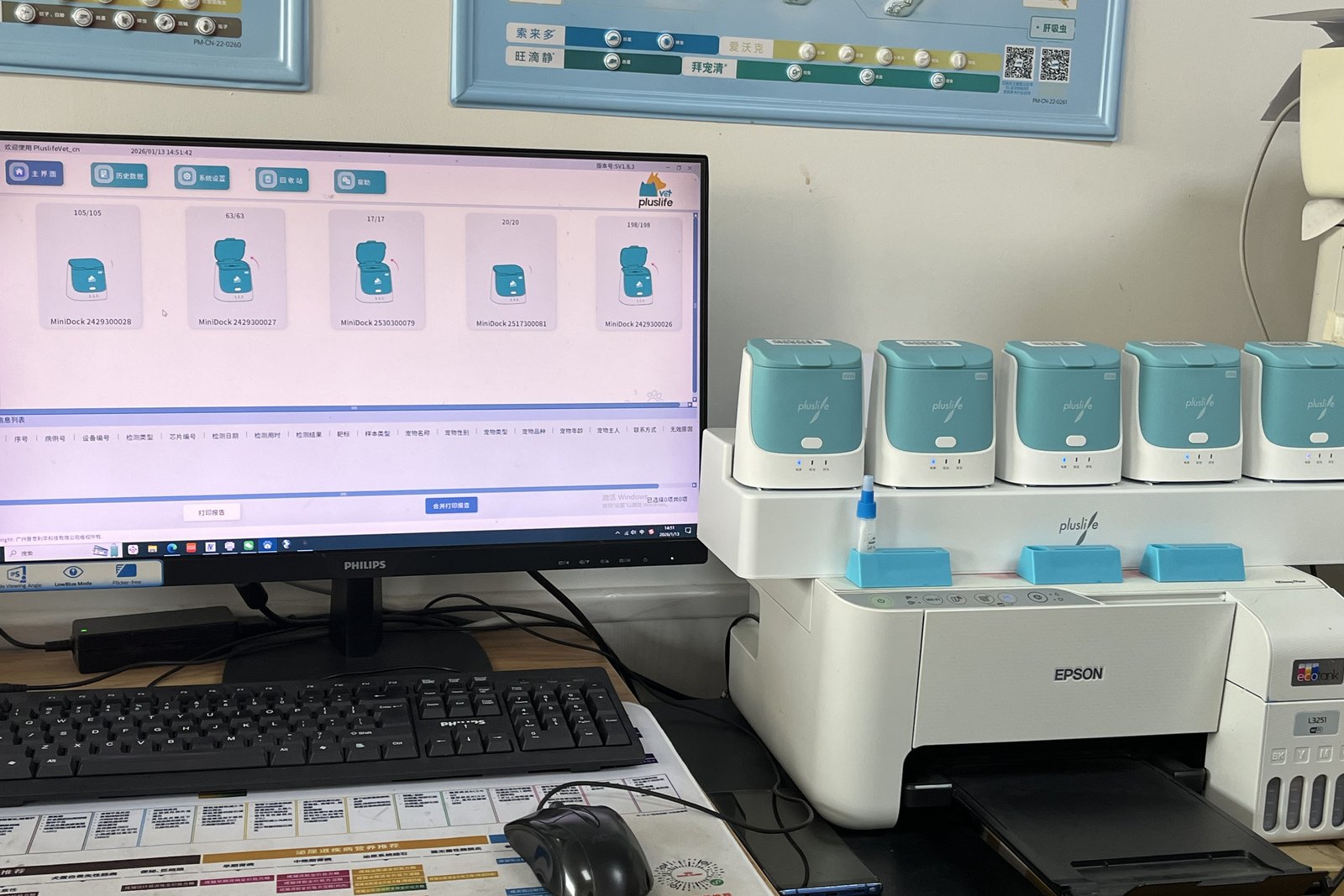
How it works
The card contains dried primers and enzymes for a panel of targets. The swab is eluted into a buffer, the buffer is pipetted into the card, and the dock holds the card at one constant temperature while amplification runs. Fluorescence is read in real time and the dock reports positive or negative per target in about 30 minutes. There is no thermal cycling and no cold chain, which is what makes the instrument small enough for a consulting room.
Where it earns its place
Respiratory disease in cats and dogs, where a panel of five or six agents (calicivirus, herpesvirus, Mycoplasma, Chlamydia, Bordetella; distemper, parainfluenza, adenovirus, influenza) decides between antivirals, antibiotics and supportive care. Diarrhoea, where parvovirus, coronavirus, Giardia and Tritrichomonas look identical in the consulting room. Any case where the owner will not come back for a second visit, and any clinic more than a day's courier from a laboratory.
Where it does not replace the laboratory
Quantitation, sequencing, resistance markers and rare targets remain laboratory work. Specimen quality still matters: a dry swab from the wrong site gives a negative result on any platform. And the card panel is fixed; if the pathogen is not on the card, the test cannot find it.
Performance
Performance is reported per card, not for the platform as a whole. For the five-target feline respiratory card the product brochure reports 94.4 to 97.0 % sensitivity and 98.1 to 100 % specificity against laboratory qPCR; independent studies of other cards, listed on the clinical trials page, report their own figures, which differ by assay. Check the data for the card you plan to use before replacing a send-out test with it.
What a clinic needs
A dock (single-channel MiniDock for a small practice, eight-channel Dock Pro for a hospital), the cards, standard swabs and a pipette. The manufacturer gives card storage as 2 to 28 °C, with no cold chain. Results export to the practice management system over Wi-Fi or USB.
Written by the Medicare Vet product team from manufacturer data, WOAH guidance and published validation. Not a substitute for veterinary or laboratory advice in your market.
Products discussed
Catalogue items that apply to this note, each with its own page, specifications and quotation form. The full line is on the isothermal amplification page.
- FCV / FHV-1 / M. felis / C. felis / Bb Nucleic Acid Test CardISO-FCV-FHV-1-Mf-Cf-Bb · FCV/FHV-1/Mf/Cf/Bb
- CDV / CPIV / CAV-2 / Bb / CIV / Mycoplasma Nucleic Acid Test CardISO-CDV-CPIV-CAV-2-Bb-CIV-Myc · CDV/CPIV/CAV-2/Bb/CIV/Myc
- Giardia / T. foetus / Parvovirus / Coronavirus Nucleic Acid Test CardISO-GIA-TRF-PV-CoV · GIA/TRF/PV/CoV
- MiniDock Ultra portable molecular analyserINS-PM003 · PM003 Ultra
Questions
Is this the same as PCR?
It is a nucleic-acid amplification test with the same targets and comparable sensitivity, run at a constant temperature instead of thermal cycling. Results are reported as positive or negative per target.
Can it be run by a nurse?
Yes. The steps are elute, pipette, close, insert. There is no reagent preparation and the dock guides the operator on screen.
What does a card cost per test?
Between a rapid antigen test and a send-out PCR panel. Pricing depends on volume and market; ask for a quotation.
More from the blog
- Disease signs in whiteleg shrimp: 28 things a farmer sees, and the PCR that names the cause2026-10-13 · Aquaculture PCR
- Isothermal amplification vs lateral-flow vs laboratory PCR: choosing the right test for infectious disease in dogs and cats2026-09-22 · Isothermal amplification
- Quantitative immunofluorescence vs rapid tests for CRP and SAA: why a number changes case management2026-09-22 · Immunofluorescence
- Lyophilised qPCR vs wet-reagent PCR and LAMP for shrimp pathogen screening on the farm2026-09-22 · Aquaculture PCR
- Multiplex real-time PCR panels vs single-target tests: syndromic testing in the veterinary laboratory2026-09-22 · Real-time PCR
- EHP in shrimp: why the hepatopancreas looks normal until it is too late2026-09-21 · Aquaculture PCR
- White spot syndrome virus: three to ten days from first sign to empty pond2026-09-21 · Aquaculture PCR
- How to read a veterinary rapid test correctly, and when not to trust it2026-09-21 · Rapid test